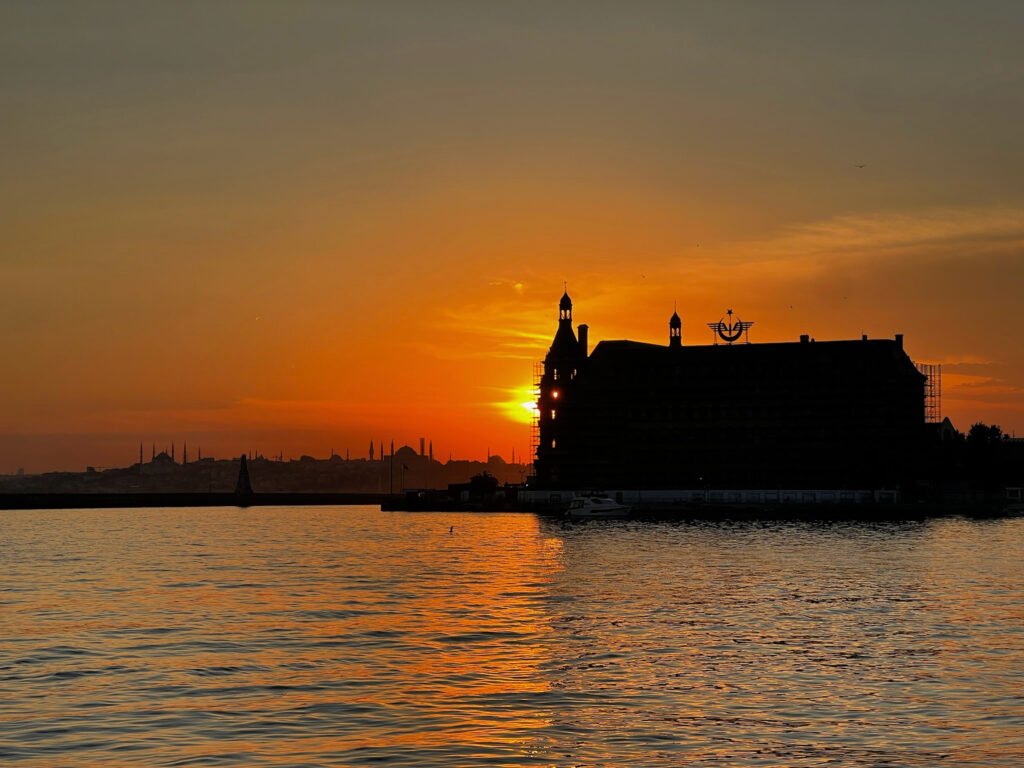
It is three weeks since we returned from Istanbul. The luggage is put away, the laundry has stopped carrying useful evidence, and I can already feel the journey arranging itself into a cleaner story than the one we actually took.
By the time we went, the world had been open for a while. Mine had not fully expanded with it.
Hong Kong had spent the COVID years intensely connected and impossibly far away. Flights vanished, borders hardened, and travel became a calculation involving tests, quarantine, changing rules, and the possibility that leaving might be considerably easier than getting home.
Oscar experienced that contraction more literally. He was working in closed-loop transit, flying in and out of Hong Kong only to be locked in hotel rooms between flights. Part of our early relationship took place on opposite sides of hotel glass. I bought us a bottle of wine and McDonald’s each, had his share sent up to his room, then sat outside by the road with mine. We talked on FaceTime, with my phone balanced on a fire hydrant, and waved through the window whilst I sweated in the Hong Kong heat and cockroaches moved around me. It was not a conventional date, but conventional dating had been suspended.
We met, built a life, and got married inside that contracted world. What we had not managed was a proper overseas trip together.
Istanbul became the first.
We left Hong Kong, travelled through Shanghai, and arrived in a city that manages to occupy Europe and Asia at the same time. After years in which crossing a border had become a serious undertaking, we had chosen somewhere that allowed us to change continents in an afternoon. This was not the reason for going, but it was a considerable improvement on quarantine paperwork.
Shanghai made sure the banality of air travel returned with interest. Our connecting flight to Istanbul was at one in the morning. When we arrived at Pudong, we found the lounge and had a shower, emerging clean and briefly human. We then discovered that the airport's air-conditioning had been switched off at 11 p.m. The terminal spent the next two hours methodically undoing the shower before we had even boarded.
The Shanghai–Istanbul flight takes roughly twelve hours. Ours began uncomfortably, offered no in-flight entertainment, and supplied me with precisely one fucking beer for the entire journey. Twelve hours is a long time to stare at a seatback that refuses to entertain you, and longer still to contemplate beverage rationing at altitude. Thank the universe for my iPad and my husband proffering his beer. The flight eventually did something useful and carried us to Istanbul.
Learning the city together
Our first full day moved through Beyoğlu and Fatih beneath a sky of almost aggressive blue. We followed the streets until they released us at the water, with domes and minarets rising behind us and ferries moving across the Bosphorus as though changing continents were simply part of the commute. Istanbul announces its history vertically, then expects ordinary life to carry on beneath it.
The city was too large to approach sensibly, so we did what travellers do when sense has failed: we began walking.
Travelling with somebody exposes a collection of small negotiations that ordinary life can keep hidden. How long do we stop here? Is this lunch or merely food encountered before lunch? (O has many stops for food, I do not). Does the person taking the photograph also need to be in every photograph? (O needs to be, I do not). How many sets of steps can be described as “not far” before the phrase loses all legal force? (This is my failing — harking to my father, "It's just around the corner").
We learned the mechanics as we went. O stopped for food and made sure he appeared in the photographs. I kept walking and substantially underestimated the distance to whatever came next. Between us, we saw more of the city, ate more regularly than I would have done alone, and acquired a collection of photographs containing at least one of us.
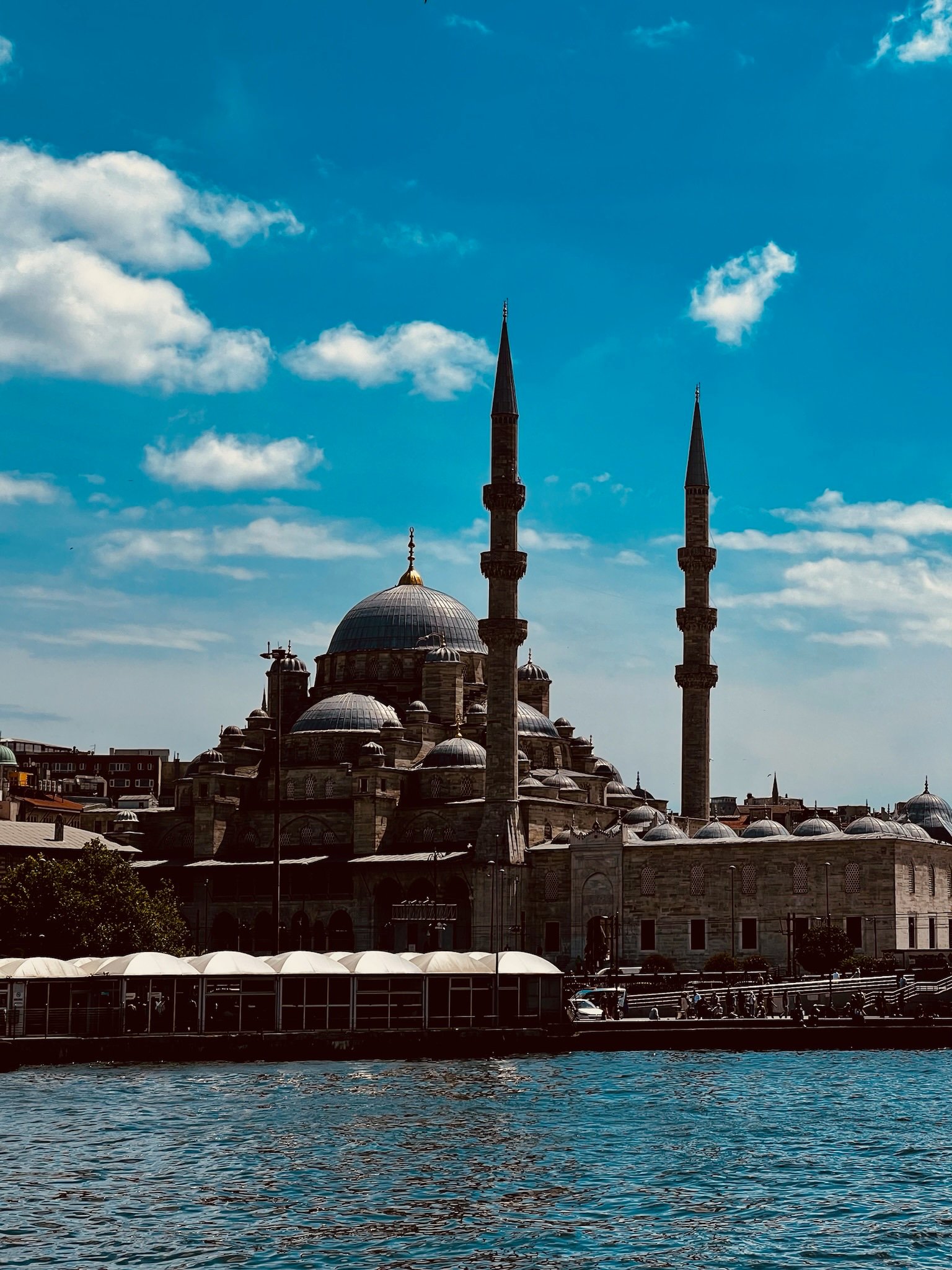
The mosques organised the skyline before I had any idea how the streets fitted together. From the water, domes rose in layers and minarets made useful markers. On foot, the scale changed again. Courtyards opened out of crowded districts, stone interiors cut through the heat, and something that had been part of the skyline became a building we could walk into.
I had spent years looking at cities through architecture: what people build, what they preserve, what they remove, and what they later pretend was always meant to be there. Istanbul offered no clean separation. Roman, Byzantine, Ottoman, and modern lives occupied the same route. The city had been renamed, conquered, expanded, and reinterpreted, but had never become a finished thought.
This suited me. I do not entirely trust places that appear complete.
History, with lunch
The following days carried us through Sultanahmet, around Hagia Sophia and the Blue Mosque, across courtyards, through markets, and repeatedly back towards the water. Monumental places can make a traveller feel temporarily scholarly. A plaque is read, a fact is repeated with confidence, and for several minutes one becomes the sort of person who has always understood the later Byzantine period.
Then somebody needs the toilet, wants lunch, or has lost the entrance ticket.
These interruptions are useful. They stop history becoming scenery and, more importantly, stop the traveller becoming unbearable.
Within a couple of days, Beyoğlu had become somewhere we returned to rather than another district to complete. We had spent the first days trying to absorb Istanbul at walking pace, moving from one historical claim to the next until even wonder required a chair. We stopped at a café and let the city continue without us for a while.
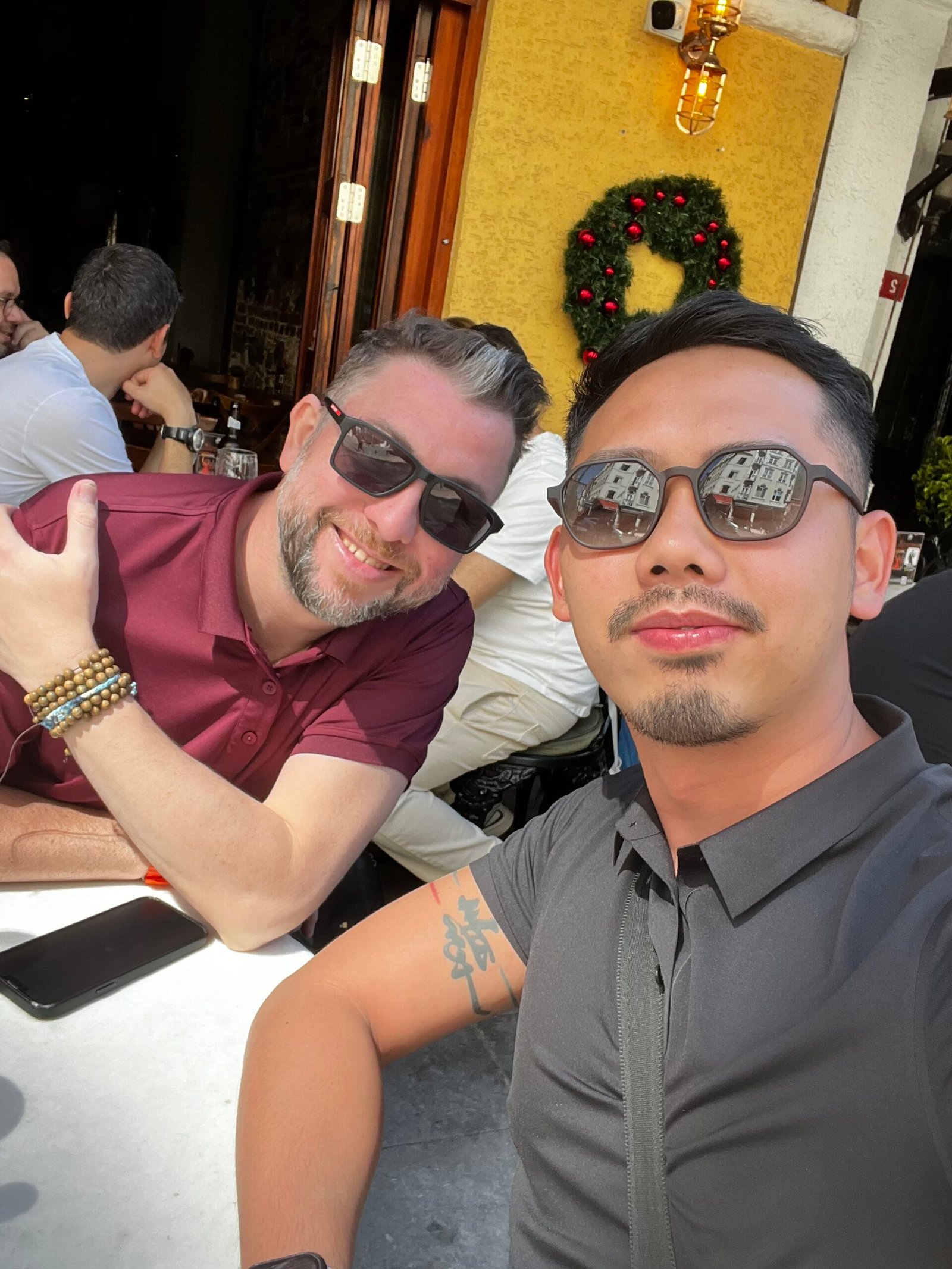
Stopping was part of the journey, even if I was usually the one who needed persuading. There was a table, shade, and the temporary certainty that I was not about to describe another hill as “just around the corner”. Istanbul had stopped being a collection of places we ought to see. We were working out how to move through it without one of us starving and the other becoming impatient.
For years, maps had become diagrams of restrictions: where we could enter, what test was required, how long we might be confined on return, and whether a journey was worth the administrative aftermath. Istanbul returned the map to its more interesting purpose. It showed streets we had not walked, water we had not crossed, and a far shore that required only a ferry.
The other side
A few days into the trip, we crossed to the Asian side.
Writing that still makes it sound like a far greater undertaking than it was. Europe and Asia were ferry stops, neighbourhoods, and views from the water. We moved through Üsküdar and towards Beylerbeyi, while the skyline we had been standing inside became something we could look back upon.
The journey from Asia to Europe had taken roughly twelve hours from Shanghai alone. Our return to Asia across the Bosphorus took a fraction of the time. There was no security queue, no boarding group, and no opportunity for the drinks service to disappoint me again. Europe receded behind us, Asia approached, and the ferry carried on as though this were not geographically remarkable.
Hong Kong had already taught us that a city often makes more sense from the water. Roads conceal distance; ferries reveal it. Istanbul offered the same useful correction, although with rather more empire attached.
At Beylerbeyi, we stopped beneath the bridge with the Bosphorus moving past us. Europe was now across the water, and Asia was beneath our feet. We had crossed a continent together before lunch and felt entitled to be disproportionately pleased with ourselves.
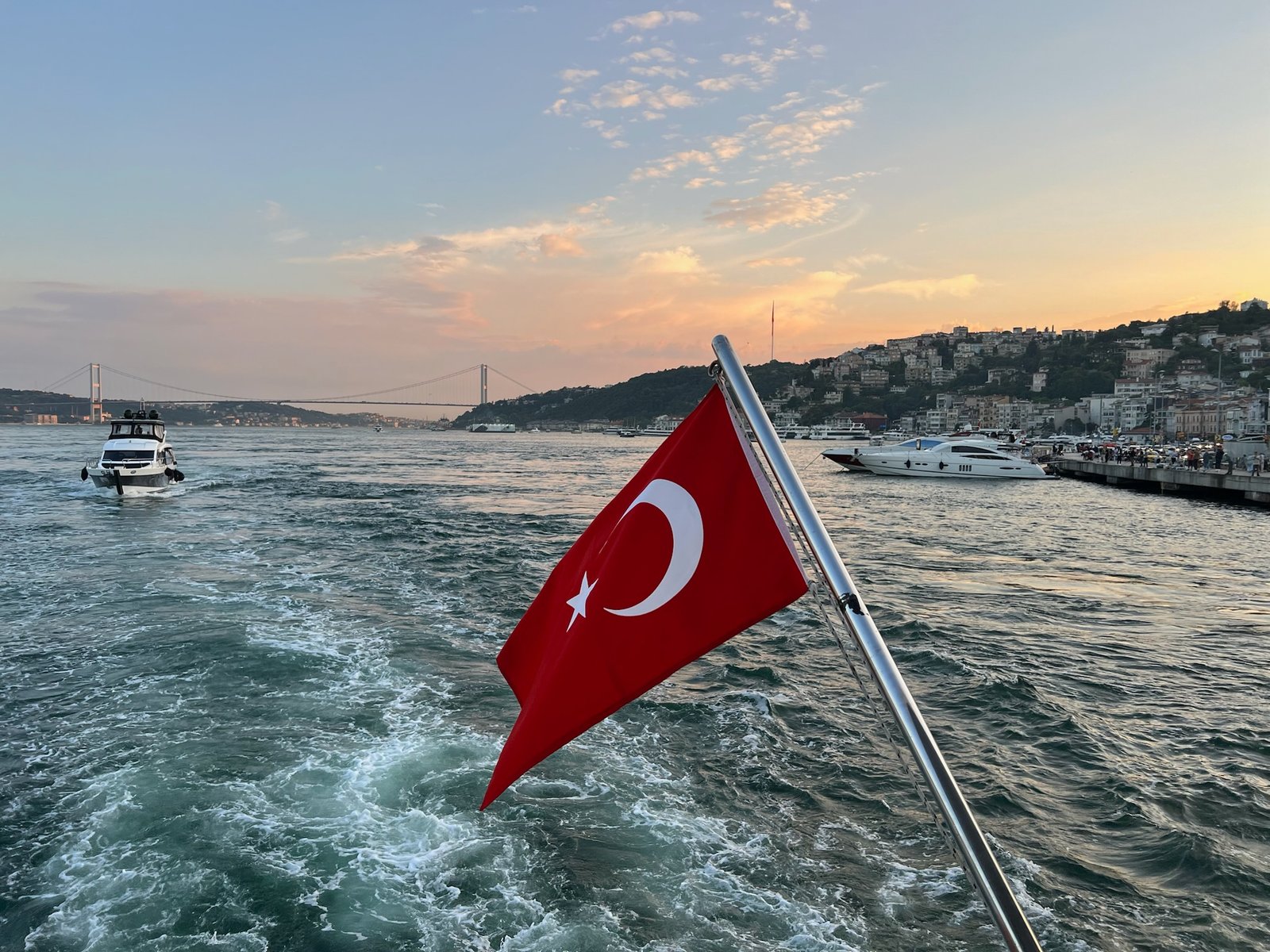
Istanbul is routinely described as a bridge between continents, which is accurate but makes the city sound suspiciously like marketing copy. The physical bridge was more interesting. It carried ordinary traffic while the Bosphorus moved beneath it, and we stood on the Asian side feeling pleased with a crossing that thousands of people made without ceremony every day.
The ease of it still felt strange. Borders and crossings had occupied too much of the preceding years. Here, we wanted to see what was on the other side, so we went. Nothing more was required.
Beneath, above, and back again
Later, we went underground into the Basilica Cistern. After days of hard sun and open water, the descent changed the city at once. Columns disappeared into shadow, arches repeated into the distance, and shallow water caught the light in colours the stone could not produce on its own.
The Bond connection was not why we went. It returned to me only once I was inside. I had seen Sean Connery carried by boat between these columns in From Russia with Love, when the cistern had seemed secret, dangerous, and almost invented for the film. Now I was standing in the same space, unexpectedly joining a place beneath Istanbul to a film I had watched years before. The recognition came after the place, which made it better.
The cistern had been built to keep something essential out of sight. Centuries later, we had queued to look at it. Istanbul did this repeatedly: palace into museum, church into mosque, infrastructure into spectacle, and a practical decision made by one age becoming the reason another one bought an entrance ticket. Out of the brutal heat, it was cool, calm, and reflective.
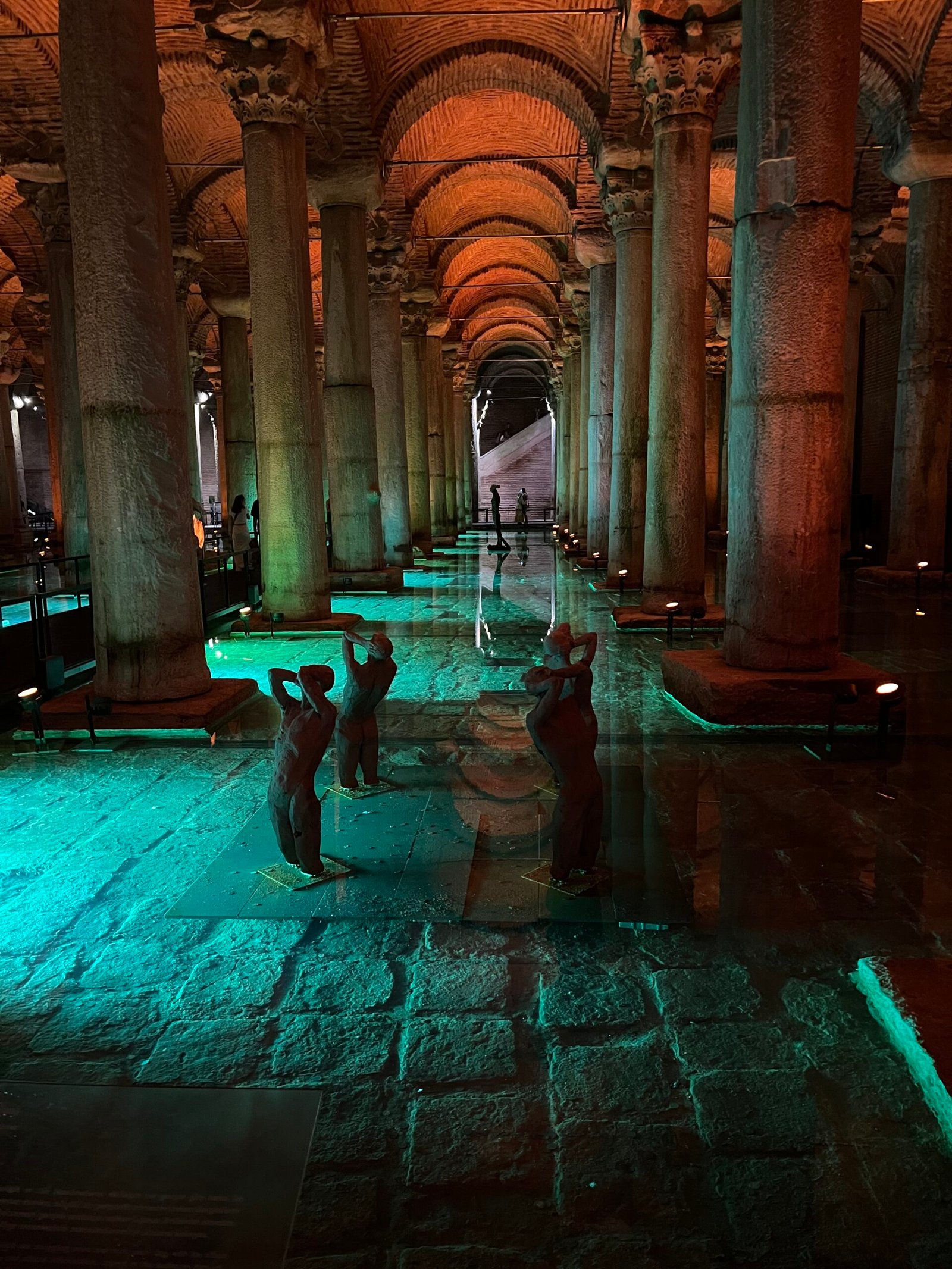
Back above ground, we moved through gardens, courtyards, stone passages, and rooms designed for lives conducted at a scale far beyond ours. By then, admiration had acquired practical limits. There were tiles, towers, views, and the growing suspicion that civilisation had produced enough stairs.
Oscar knows I can be impressed by a building and irritated by its queue within the same five minutes. I know that hunger will eventually become his principal opinion of wherever we are. Neither of us had to maintain continuous awe for the other's benefit. We were moved, hungry, impressed, tired, occasionally annoyed, and still very glad to be there.
On our final morning, we climbed the Galata Tower. The city opened beneath us: water, rooves, mosques, ferries, and the routes we had spent the week making without ever quite understanding their shape.
From above, the city looked almost coherent. Height does this. Streets appear orderly, distances manageable, and all previous wrong turns part of an elegant plan. They were not.
By the time we reached the airport, O and I were better calibrated. I knew when food had moved from a suggestion to a necessity; he knew that “just around the corner” was an inherited unit of family measurement rather than a geographical fact. We were tired, occasionally annoyed, and very glad we had gone.
Not long before, Oscar had been locked in a hotel room while I sat beside the road with McDonald’s, wine, and cockroaches for company. Now we had taken a ferry from Europe to Asia simply because we wanted to see what was on the other side.
Three weeks later, the world beyond Hong Kong feels available again — not as an abstraction, a postponed plan, or a set of border rules, but as somewhere we can actually go.