Market research has traditionally been very good at asking a question, and remarkably patient about receiving the answer.
I have never been especially patient.
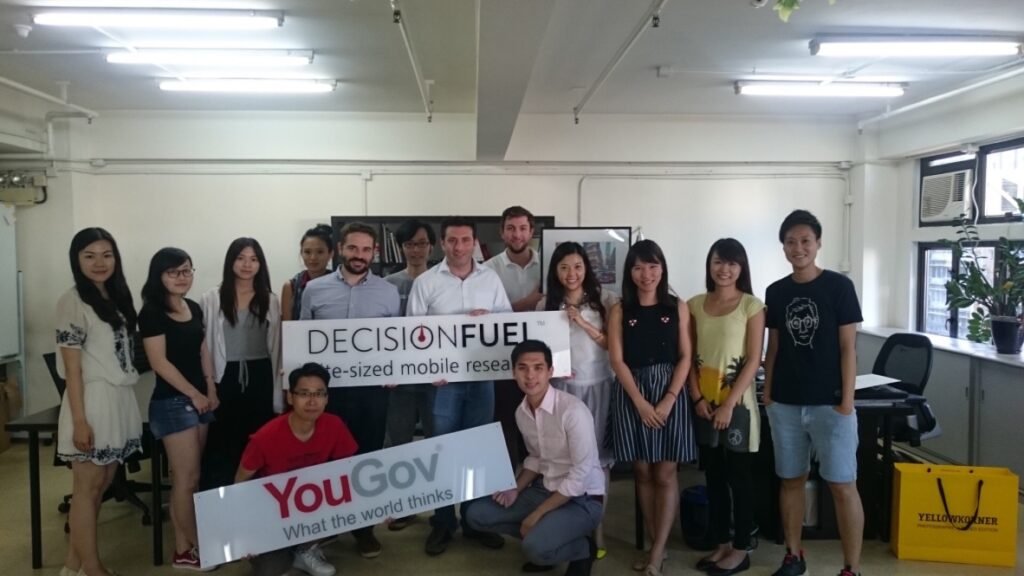
This week, YouGov acquired Decision Fuel, the mobile research company we have been building across Hong Kong, Shanghai, and Singapore. The announcement talks about regional expansion, emerging markets, and extending YouGov’s reach into China and South-East Asia. All true. The part I keep returning to is smaller: we shortened the distance between a question and a useful answer.
Decision Fuel began with a fairly obvious observation. Asia was not waiting to become a smaller version of somebody else’s internet. People were coming online through different devices, at different speeds, and often without the fixed-line connections or expensive smartphones that much of the research industry quietly assumed.
Putting a conventional survey onto a smaller screen would not solve that. It would simply make the inconvenience more portable.
The system had to be reconsidered from the respondent backwards: how a question arrived, how little data it required, what happened when a connection disappeared, and how quickly an answer could become part of a reliable sample. Then the same treatment had to be applied to the client side. Setting up a study, finding the right people, monitoring its progress, and receiving the results could not remain a procession of spreadsheets and hand-offs merely because the respondent had gone mobile.
The phone was the visible change. The operating model was the real one.
I first became involved as an adviser and then moved into the technology role full-time. What we built was a single, white-labelled platform covering the research lifecycle: clients, studies, respondents, sampling, responses, and delivery. In six months, more than a million people had been onboarded. The platform could process 10,000 responses a second, and a piece of research that once took considerably longer could move from question to usable insight in less than 24 hours.
Those numbers sound like a story about infrastructure. They are really a story about decisions.
Faster systems are not automatically better systems. A survey completed quickly but filled with the wrong people produces a wrong answer with admirable efficiency. Research needs a balanced sample: as responses arrive, some groups fill sooner than others, and the remaining flow has to be directed without distorting the result.
I borrowed part of the solution from banking.
Trading systems continuously observe a changing market, route demand, and adjust as positions fill. A research sample presents a related problem with different consequences. Rather than prices and orders, we were dealing with people and demographic quotas, but the system still needed to understand its state and decide what it required next. Applying that logic allowed the platform to fill studies faster while protecting the shape of the data.
The useful innovation was not inventing an entirely new idea. It was recognising that a method proven in one industry could solve a problem in another.
Start-ups encourage this kind of theft with good intentions. There is rarely enough time, money, or patience to preserve the boundaries between disciplines. You take what works, understand why it works, and adapt it carefully enough that it does not become cargo cult architecture with a fashionable diagram.
Clients made the platform better and more difficult in roughly equal measure. Every new organisation arrived with a different process, a different priority, and a firm conviction that its exception was essential. Some of those exceptions revealed genuine improvements. Others were old habits wearing the costume of requirements.
The challenge was deciding which requests strengthened the product and which would turn it into a collection of bespoke compromises. Saying yes to every client is not customer focus. It is a slow way of losing the thing they wanted to buy.
We occasionally received a more direct form of validation. At least two established research businesses discussed acquiring Decision Fuel in terms that included the word “destroy”. There are warmer compliments, but few quite as clarifying. If an incumbent would rather remove a system than compete with it, the system has probably disturbed something worth disturbing.
Now Decision Fuel becomes part of YouGov. We bring a proprietary mobile platform, a panel of people across five countries, and a team of fourteen who have built a surprising amount from Hong Kong. YouGov brings global scale, established products, and the opportunity to take what we have learned considerably further.
An acquisition is often presented as a conclusion. It feels more like a change of scale.
The lesson I am carrying into that next stage is that digital transformation does not begin with a device. It begins when an organisation stops protecting the delay built into its existing process. Mobile mattered because it changed who we could reach. The platform mattered because it changed what could happen after they answered.
The company has a new name above the door. The question remains the same: how much distance can we remove between people, information, and a decision without losing the value of any of them?
A million people later, the interesting thing is still not the number. It is how much closer the answer has moved.