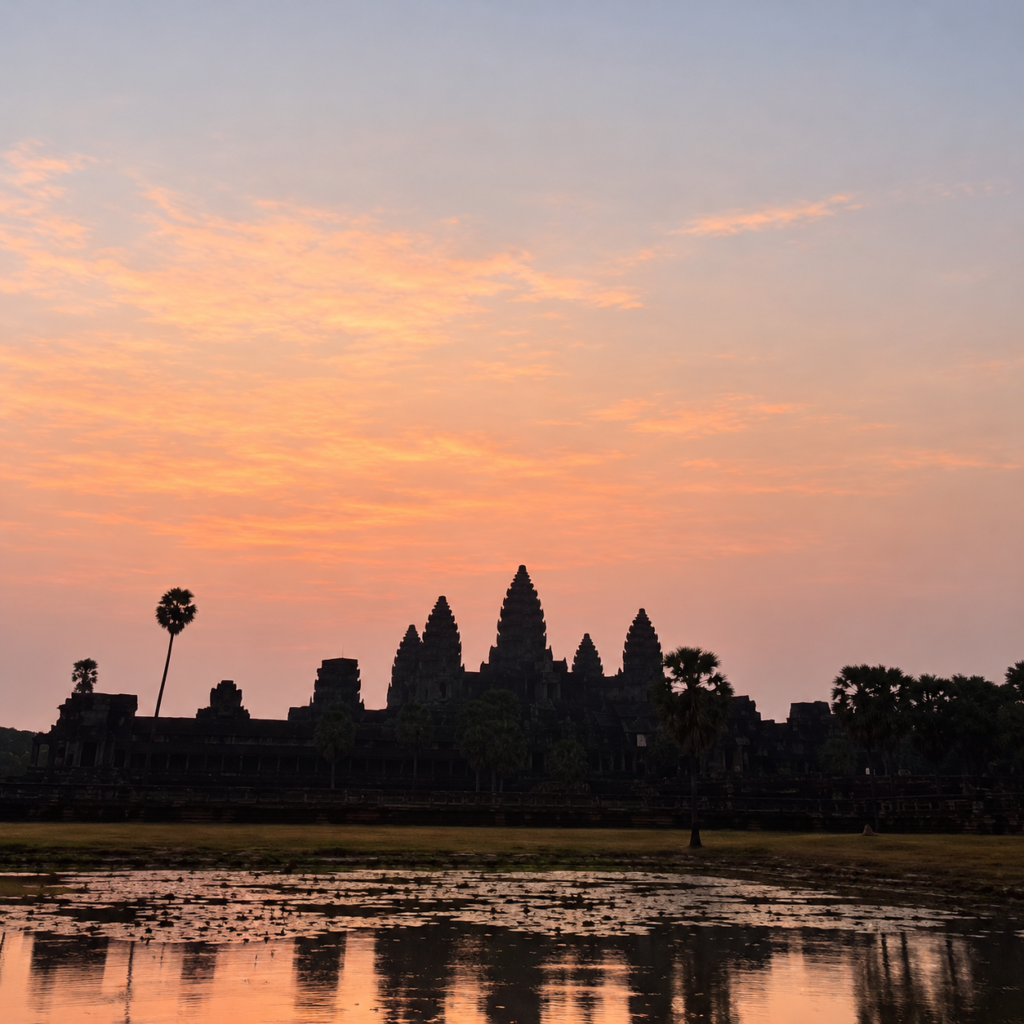
Angkor Wat had been on my list for more than twenty years before I finally arrived. Not a sensible list, organised by geography, budget, or the amount of annual leave available, but the other sort: the collection of places that settle in the imagination long before there is any realistic prospect of reaching them.
Some of that began with Tomb Raider. An early encounter with Lara Croft had rendered the temples of Cambodia as somewhere between archaeology and another world: stone consumed by roots, doorways leading into darkness, and history waiting for somebody reckless enough to disturb it. The film also pulled at Blake — “To see a World in a Grain of Sand” — and that line stayed with me. The idea that something apparently small might contain a complete universe has always felt less like poetry than a useful warning not to pass too quickly.
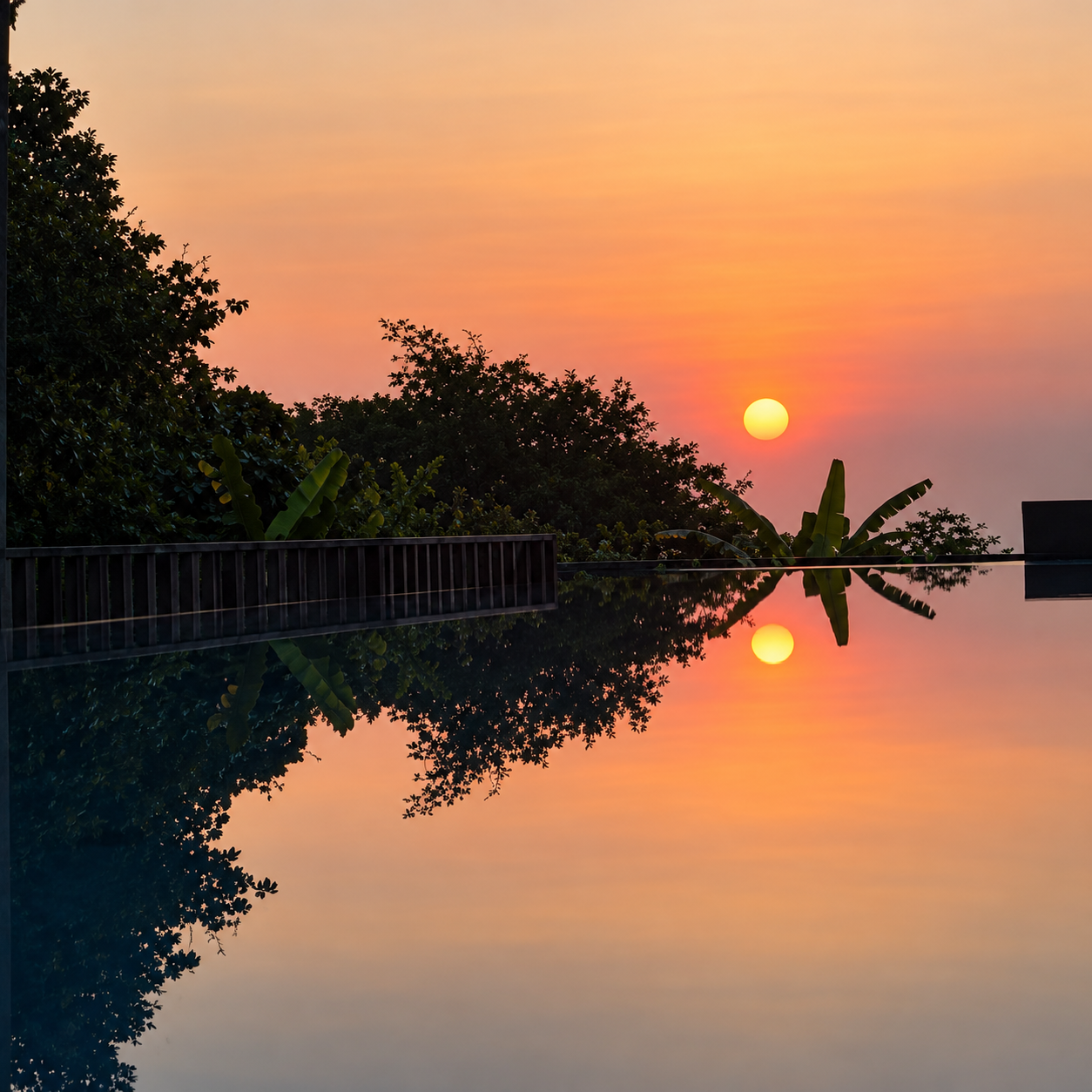
Cambodia had already begun slowing me down. In Kep, there was a pool held between dense green planting, low buildings, and a sky that seemed determined to perform even when nobody had requested it. The surface caught the light and returned a second version of the scene. It was an ordinary luxury and, because travel changes the scale of things, briefly the only place in the world that mattered.
I had also gone into Cambodia carrying a decision that had nothing to do with temples. I needed to decide whether my next employer would be Prudential. Career choices rarely become clearer merely because they have been taken through an airport, but distance does remove some of the surrounding noise. There was time to think, no familiar routine to hide inside, and an entire country insisting that my normal scale of importance might require adjustment.
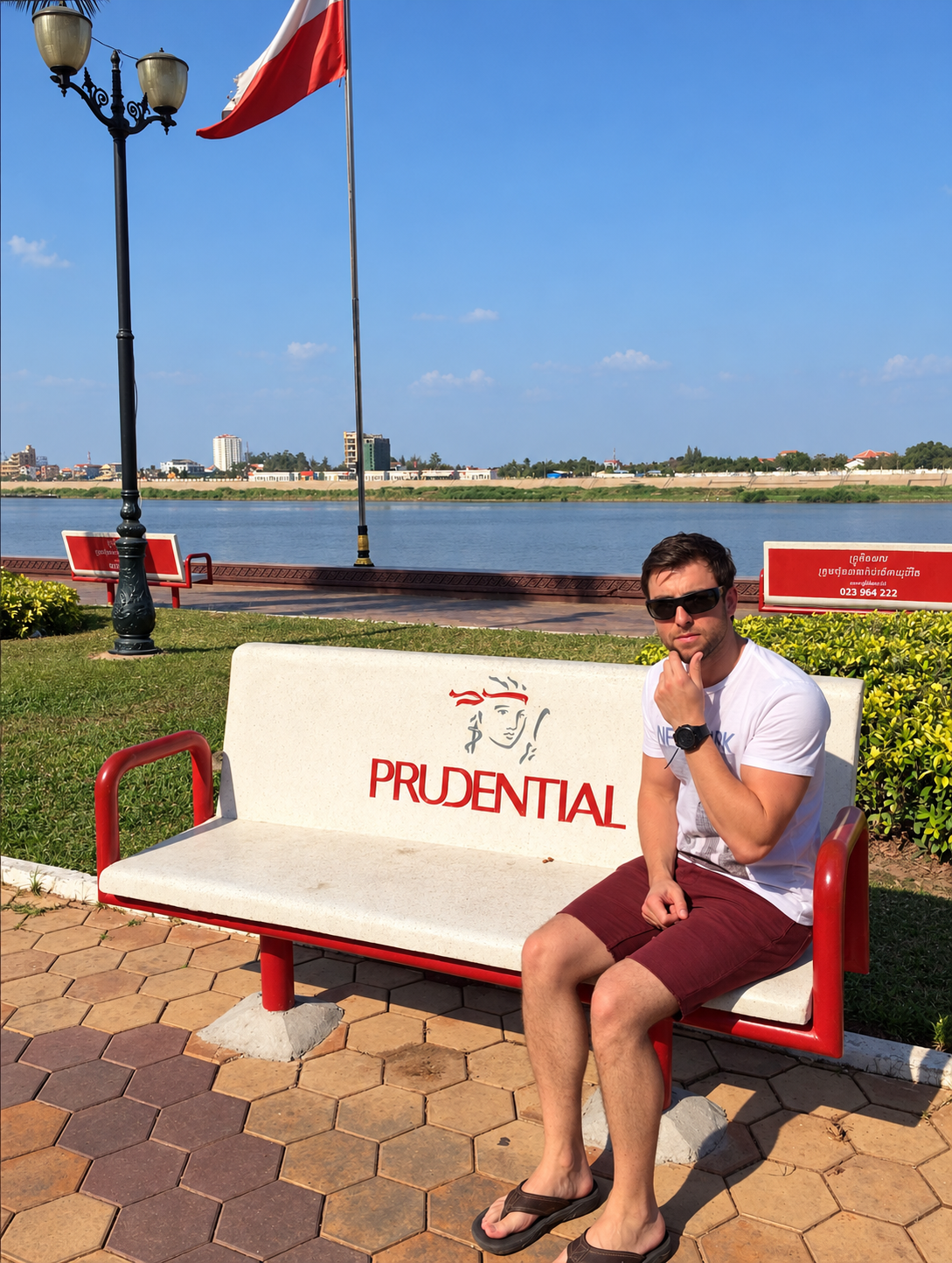
In Phnom Penh, I found a bench with PRUDENTIAL written across it and sat down. There is a photograph of me there, hand against my face, apparently engaged in serious contemplation. It is almost too neat a metaphor. One suspects the marketing department had arranged the entire trip.
I made the decision in Cambodia. Prudential it was. A fortuitous endeavour on many fronts.
I also found myself in two Cambodian places carrying the FCC name: the Foreign Correspondents’ Club in Phnom Penh and FCC Angkor in Siem Reap. They felt like places Hemingway ought to have frequented, which was part of their appeal to me. He did not — both venues opened long after his death — but they inhabited the mythology of foreign correspondents, strong drinks, distant places, and sentences written under ceiling fans.
I did not have a typewriter to lug between them, only an iPhone: lighter, less romantic, and rather better at recording the moments when I should have been writing.
Then came Siem Reap, a very early start, and the dark shape of Angkor Wat waiting beyond the water.
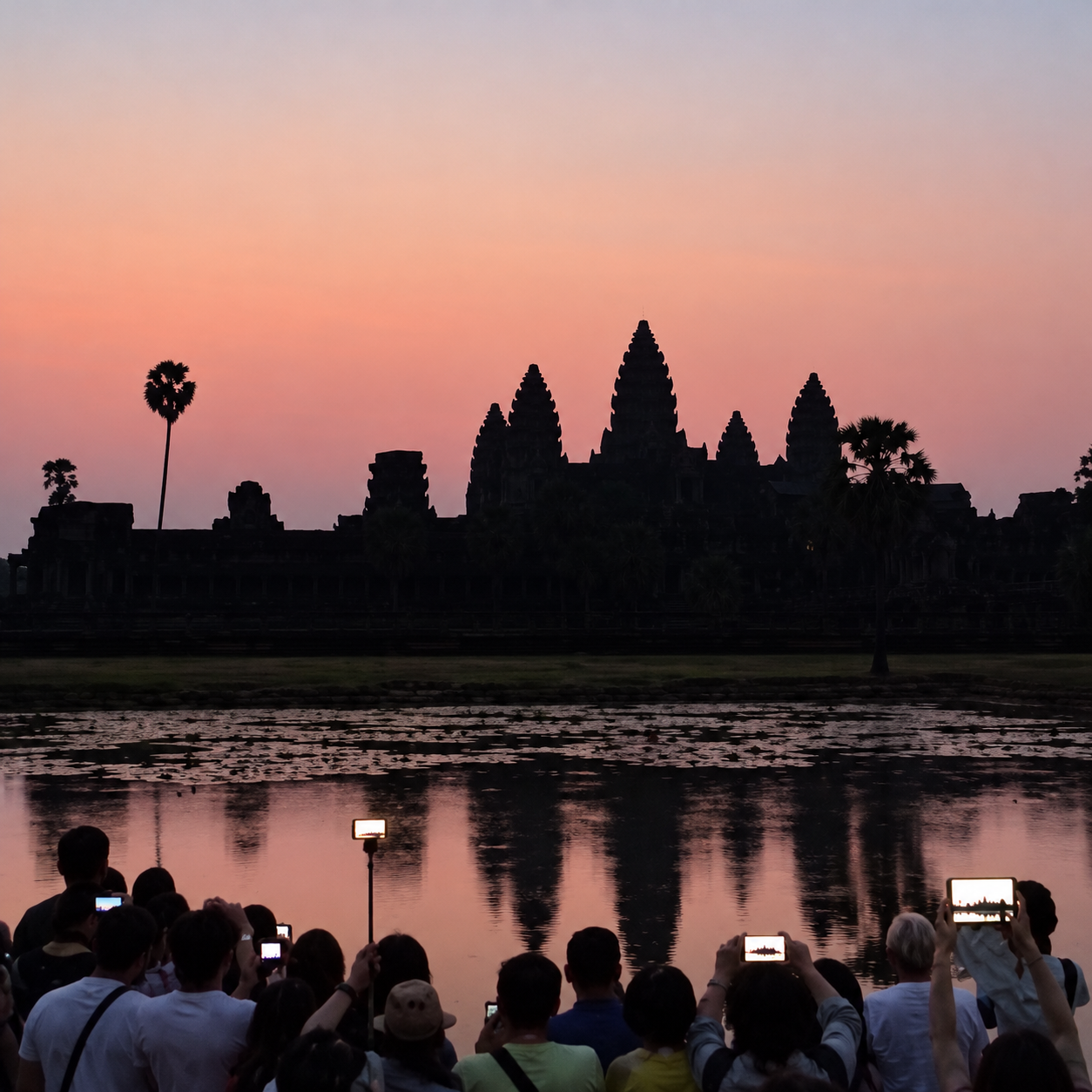
Before the sun appeared, the bank of the reflecting pool was already crowded. There were too many iPhones in the air, each trying to capture the beauty of a sunrise that was plainly refusing to fit inside a screen. I took photographs too, of course. Hypocrisy is much easier to carry when it fits in a pocket.
At first, Angkor was only a silhouette: five dark towers, a line of palms, and a suggestion of stone reflected in water. The sky moved through bruised violet, dusty pink, and pale gold. Details emerged slowly, as though the temple were being developed in a darkroom. The crowd quietened and then, inevitably, began again — shutters, whispers, elbows, somebody moving directly into everybody else’s photograph, and hundreds of small screens insisting that the experience had happened.
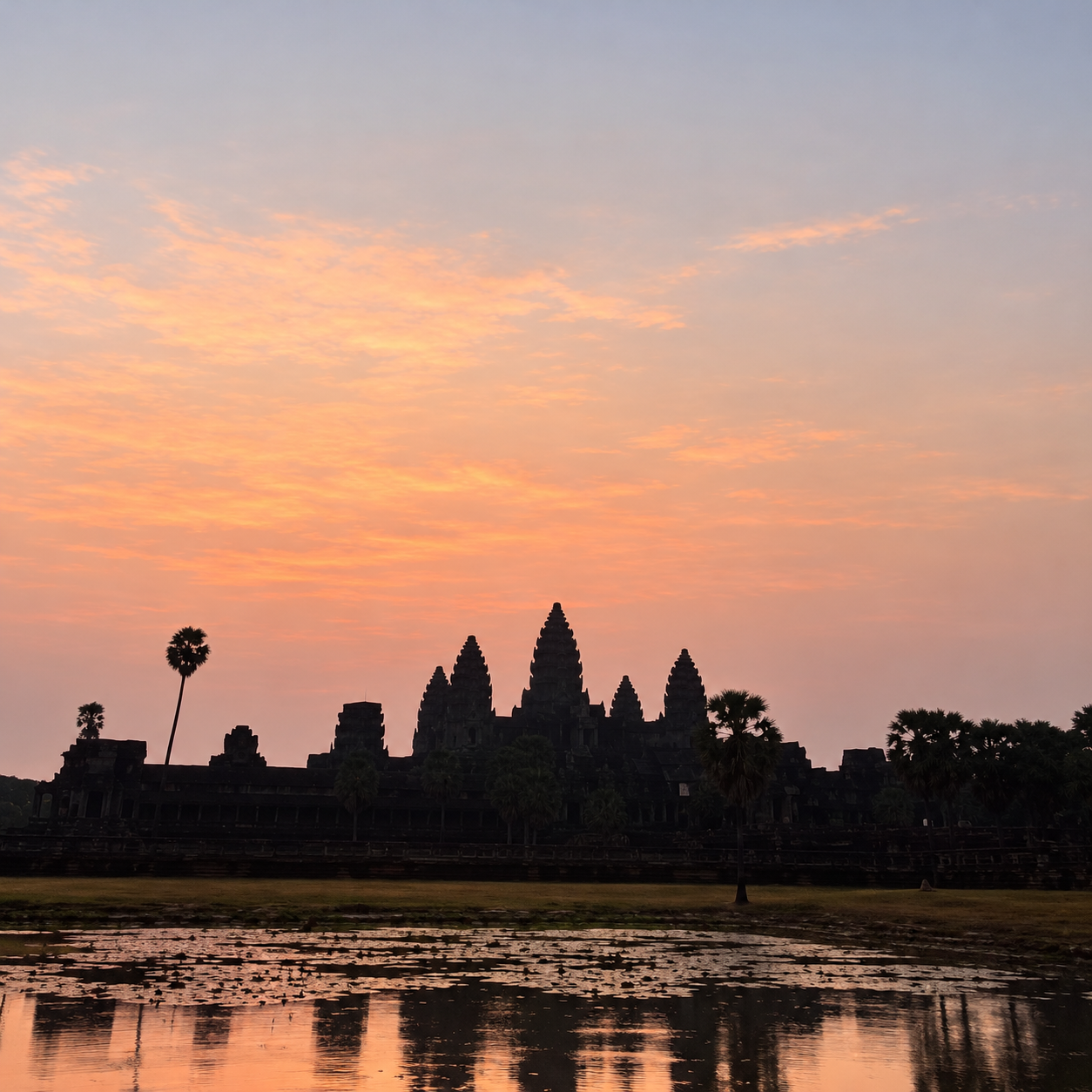
There is a cleaner photograph from that morning, and another with the crowd visible at the bottom of the frame. I prefer them together. One records the monument as we imagine it; the other records what it was like to be there. Awe, even at sunrise, has logistics.
The approach to Angkor Wat is a deliberate crossing. The causeway stretches over the moat towards the western entrance, its balustrades formed by the long bodies of nāgas. It is often described as a rainbow bridge: a route from the ordinary world towards the realm of the gods. Standing there, still not properly awake, my mind wandered from Cambodia to Bifröst, the rainbow bridge of Norse mythology, and from Bifröst to the cinematic idea of an Einstein–Rosen bridge — a fold in space, a passage between places that should be impossibly far apart.
This is not, I appreciate, rigorous comparative mythology. Nor is an ancient Khmer causeway a wormhole. It was early.
Still, thresholds matter. Films understand this, religions understand this, and architects certainly understand this. A bridge creates a before and an after. On one side were buses, guides, coffee, ticket checks, and the practical machinery of tourism. On the other was a structure intended to describe a universe in stone.
I had once wanted to study astrophysics at university. I wanted the large questions: stars, distance, time, gravity, and what sits beyond the edge of what can be observed. A year out disturbed that plan, as years out are supposed to do. Looking up at the stars did not stop, but the desire to understand the universe became mixed with a desire to see more of this one. Theory had scale; travel had texture. Both began with the same impulse. Look up. Go closer. Try to understand what you are seeing.
Inside Angkor Wat, scale becomes detail. Long galleries carry processions of figures across the stone: warriors, gods, animals, chariots, battles, and ceremonies, all cut into a surface that has survived weather, war, vegetation, restoration, neglect, reverence, and the persistent touch of human hands. From a distance, the wall appears patterned. Up close, the pattern becomes a population.
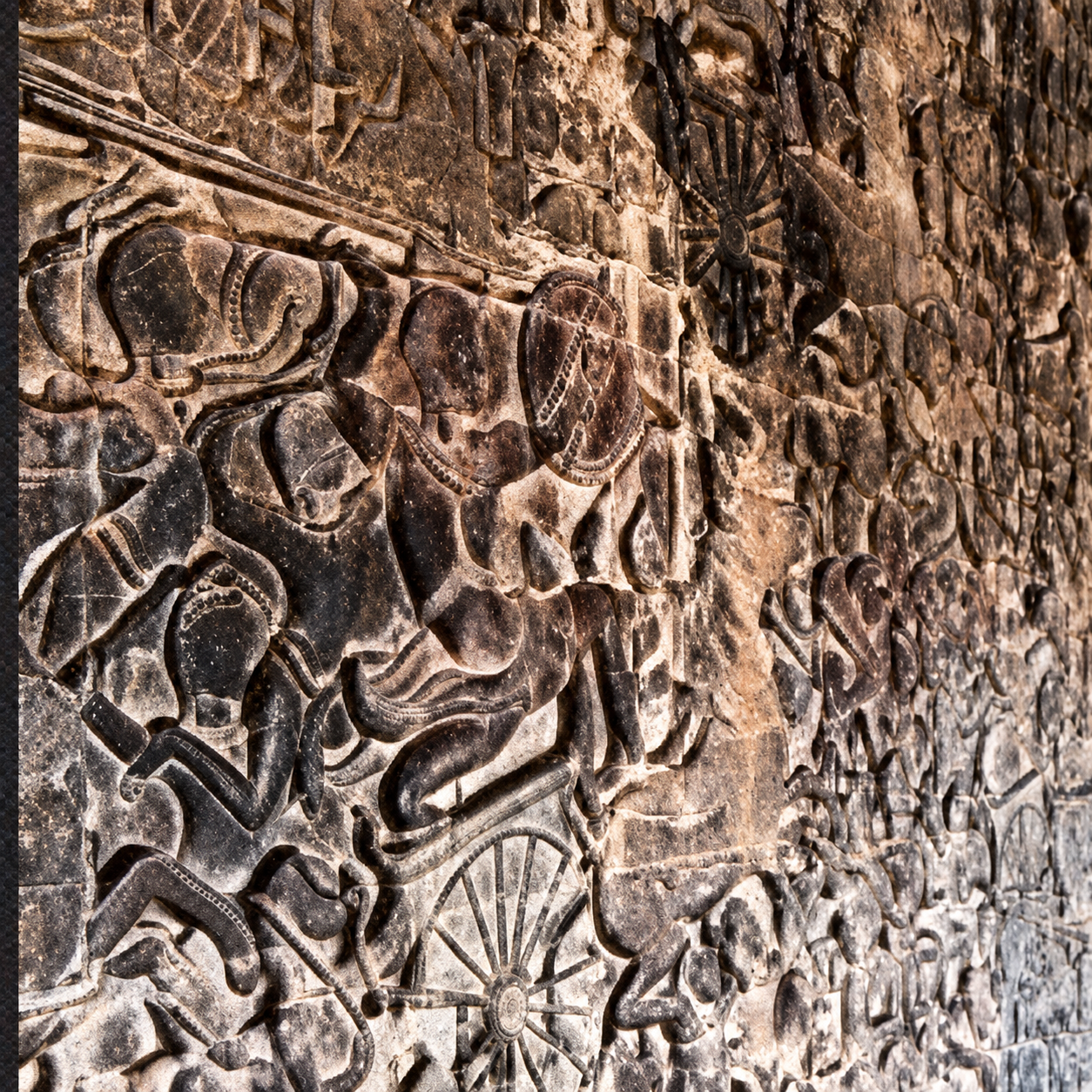
This was Blake’s grain of sand rendered in sandstone. A hand, a wheel, the curve of a headdress, or the expression on a face became an entrance into a much larger story. I could not read every scene and did not pretend otherwise. Part of the pleasure was knowing that the building exceeded me: too large to comprehend at once and too detailed to finish by inspection.
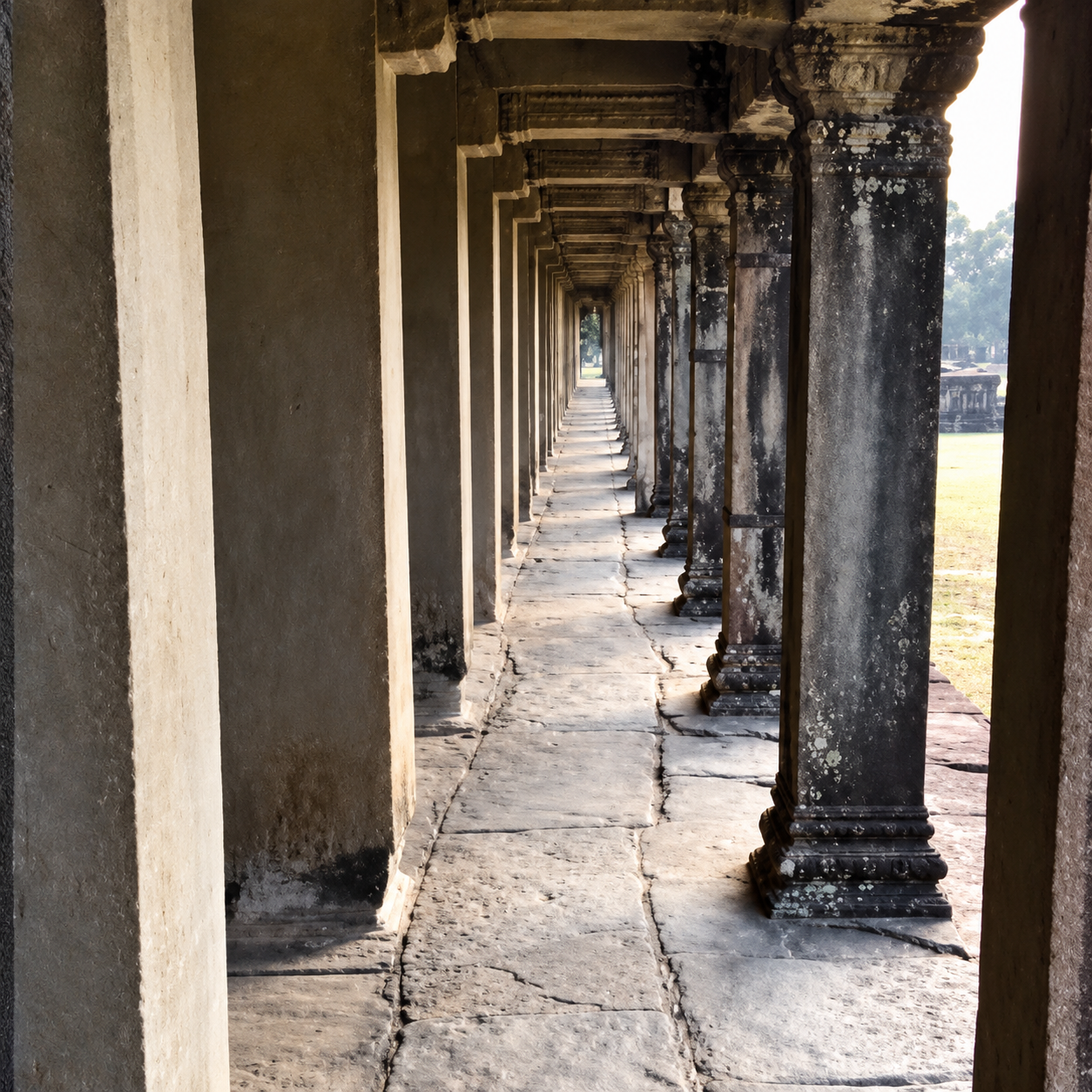
The colonnades performed a different trick. Each doorway framed another doorway, each column repeated into the distance, and light moved across the stone in alternating bands. Walk a few steps and the composition changed. Stop, and it appeared infinite.
I had read Graham Hancock’s Heaven’s Mirror, with its suggestion that sacred buildings across the ancient world reflected patterns in the sky. Much of that argument is speculative and should be treated accordingly. It is seductive, though. Stand inside a temple built as a model of a cosmic order and it becomes easy to understand why people look for constellations in foundations and astronomical intention in every alignment. We are pattern-making creatures. Give us enough stars and enough stones, and we will start introducing them to one another.
Yet the broader instinct does not require the theory to be true. The builders of Angkor Wat were plainly concerned with more than shelter. Movement, direction, elevation, water, light, and proportion had been arranged to place a person inside an idea of the world. The temple did not simply occupy the landscape. It explained it.
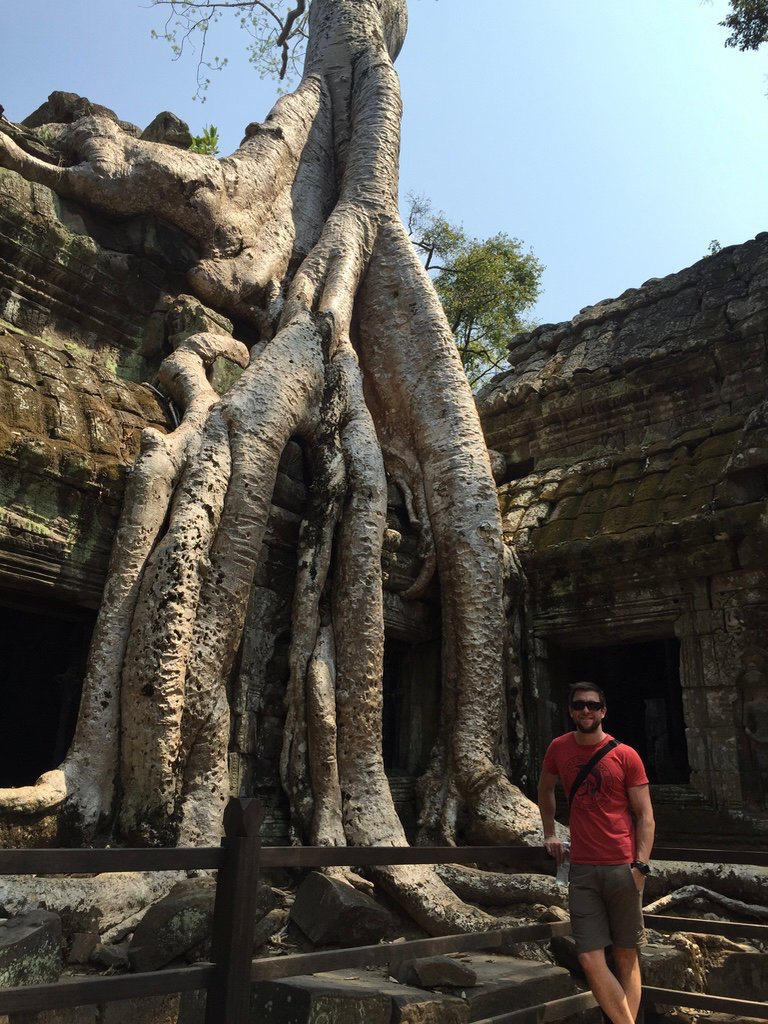
Later came Ta Prohm, where the architecture appears to be negotiating with the forest and losing with extraordinary dignity. Roots pour over walls, grip roofs, and enter openings with the confidence of something reclaiming property. This was the place cinema had sold to me years earlier, but the real experience was quieter and stranger. The trees were not decoration. They were time made visible.
By later that day there was an elephant, because apparently ancient temples, cosmology, jungle, and a large mammal can all be fitted into one tourist itinerary if everybody remains sufficiently organised. The elephant occupied the frame with the calm authority of the only participant not consulting a schedule. What remains in my memory is the size of it, the textured skin, and the awareness that the animal was experiencing a very different version of our day.
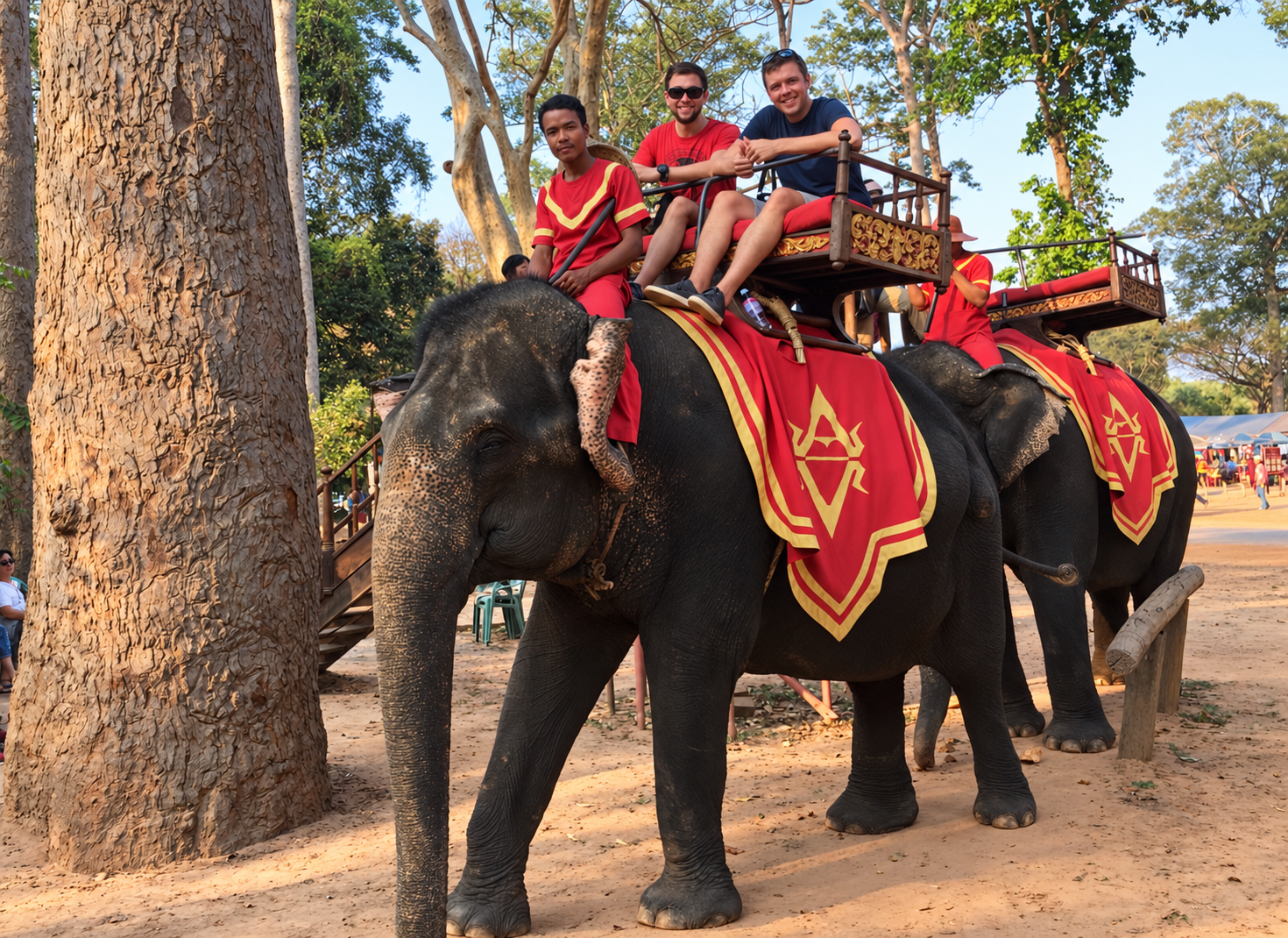
Angkor had taken more than twenty years to reach and considerably less than a day to become memory. That seems unfair, but perhaps it is why the photographs matter. Not as proof, and not because a phone can contain the place, but because each image restores a fragment: the colour before sunrise, the people along the water, a carved wheel, light between columns, the steady presence of an elephant among excited humans, and a career decision made on a conveniently branded bench.
I think again of the pool in Kep, holding the sky on its surface. Reflections are not the thing itself. Neither are photographs, films, books, myths, or travel stories. They are invitations to look twice.
The sunrise never did fit inside the screen.
Cambodia had settled one decision and supplied the beginnings of several stories. Exploration, I was beginning to understand, was less about arriving at an answer than learning which questions to carry home.